
4B2 dish grinding wheels 180x4x3x16x20x32 A B2-01 50% AC4 D 213
| D - top diameter | 180 |
|---|---|
| W - rim width | 4 |
| X - diamond layer | 3 |
| T - wheel thickness | 16 |
| α° | 20 |
| H - hole diameter | 32 |
| Body | A |
| Concentration | 50% |
| Diamond type | AC4 |
| Size FEPA | D 213 |
| Bond type | B2-01 |
| Type of Operation | Rough |
| Manufacturer | Poltava ZAI |
| Country of Manufacture | Ukraine |
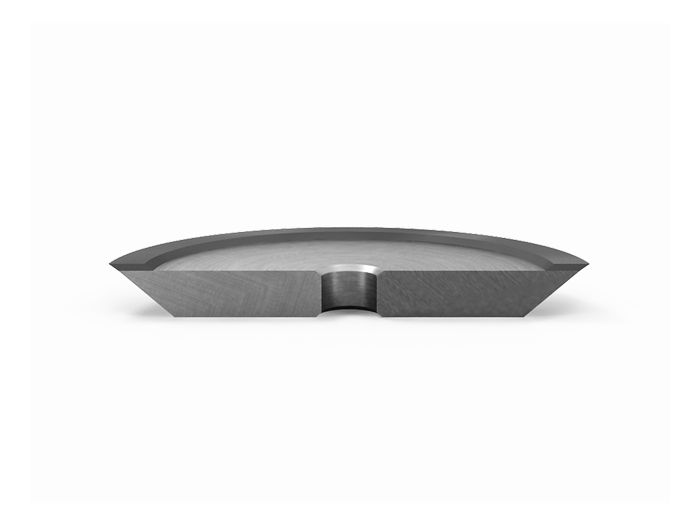


--B2-01-Bond.jpg)

4B2 Diamond Grinding Wheel – Dish Type | FEPA D213 (212/180 μm)
4B2 dish grinding wheel for extreme rough sharpening and preparation of tool face surfaces.
Designed for carbide and other hard brittle materials.
Where it is actually used:
Used for face grinding and sharpening with reduced grinding forces at the earliest machining stage.
Typical applications include:
- Initial face grinding on low-rigidity machines
- Heavy reconditioning of worn tools under unstable conditions
- Bulk material removal with limited spindle power
The dish shape provides accurate contact on flat and angular surfaces.
What it actually does:
Maximum material removal with smoother and more stable cutting behavior.
Significantly reduces grinding forces compared to higher concentrations.
Grain size (D213 ≈ 212/180 μm):
- Extreme stock removal rate
- Typical Ra ~ 2.0–4.0 μm
- Prepares surface for D181 → D151 sequence
Concentration 50% means:
- Minimum grinding forces for this grit range
- Highly open structure → excellent chip evacuation
- Lower heat generation
- Smoother and more forgiving cutting behavior
- Trade-off: reduced tool life and cutting aggressiveness
In practice:
This is a low-load extreme roughing wheel.
Used when maximum material removal is required but machine stability is limited.
Ideal for weak setups, long tools and vibration-sensitive operations.
Specification:
- Type: 4B2 (dish)
- Abrasive: Synthetic diamond (AC4)
- Grit: FEPA D213 ≈ 212/180 μm (ANSI 70/80)
- Concentration: 50%
-
Body: P / A / S / Ap
(Pressed / Aluminum / Steel / Aluplast)
Body options:
- Pressed: lighter weight, vibration damping, better surface finish
- Aluminum: lightweight with good rigidity, general-purpose solution
- Steel: maximum rigidity for heavy-duty grinding
- Aluplast: balanced weight and rigidity
Why this concentration:
- Minimum cutting forces
- Improved process stability
- Reduced thermal load
Use for:
- Face grinding
- Tool sharpening
- Low-load extreme rough grinding
Do not use for:
- Maximum productivity grinding
- Finishing operations
- High-pressure grinding