
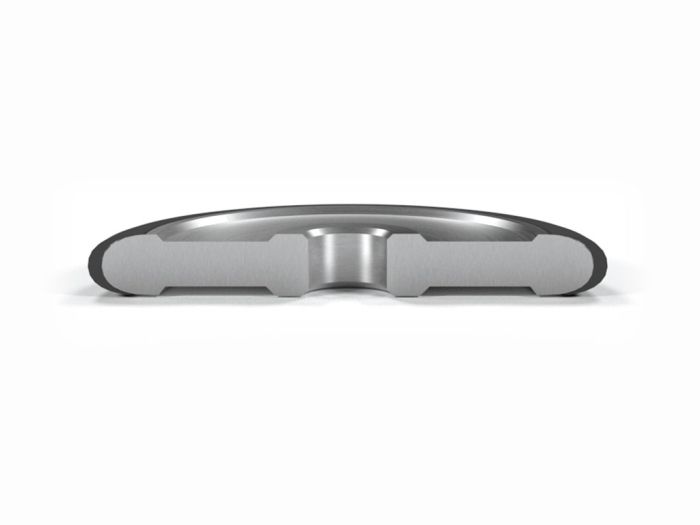
1FF1 flat grinding wheels with double-sided conical profile 125x2x4x4x32 S B2-01 100% AC4 D 151
| D - top diameter | 125 |
|---|---|
| R - radius | 2 |
| X - diamond layer | 4 |
| T - wheel thickness | 4 |
| H - hole diameter | 32 |
| Body | S |
| Concentration | 100% |
| Diamond type | AC4 |
| Size FEPA | D 151 |
| Bond type | B2-01 |
| Type of Operation | Finish |
| Manufacturer | Poltava ZAI |
| Country of Manufacture | Ukraine |


--B2-01-Bond.jpg)

1FF1 Diamond Grinding Wheel – Double-Sided Conical Profile | FEPA D151 (150/125 μm)
1FF1 flat diamond wheel with double-sided conical profile for heavy rough grinding of cutting tool features.
Designed for carbide and other hard brittle materials.
Where it is actually used:
Used for grinding chip-breaking flutes and narrow profiles at the earliest stage of machining.
Typical applications include:
- Initial shaping of chip breaker geometry on end mills and drills
- Grinding of deep and narrow flutes from solid material
- Bulk material removal before D126 / D107 sequence
The double-sided conical profile enables stable profile generation with controlled contact.
What it actually does:
Maximum material removal with minimal control of surface quality.
Quickly removes bulk material and defines the primary profile shape.
Grain size (D151 ≈ 150/125 μm):
- Maximum stock removal rate
- Typical Ra ~ 1.0–2.0 μm
- Leaves deep and aggressive grinding marks
Stable under heavy grinding conditions and high load.
In practice:
This is a primary roughing wheel.
Used as one of the first steps before D126 → D107 → D91 sequence.
Focus is speed and bulk material removal.
Specification:
- Type: 1FF1 (double-sided conical)
- Abrasive: Synthetic diamond (AC4)
- Grit: FEPA D151 ≈ 150/125 μm (ANSI 100/120)
- Concentration: 100%
-
Body: P / A / S / Ap
(Pressed / Aluminum / Steel / Aluplast)
Body options:
- Pressed: lighter weight, vibration damping, better surface finish
- Aluminum: lightweight with good rigidity, general-purpose solution
- Steel: maximum rigidity for heavy-duty grinding
- Aluplast: balanced weight and rigidity
Why this shape:
- Access to narrow grooves
- Controlled profile generation
- No interference in tight areas
Use for:
- Chip breaker flutes
- Tool profile grinding
- Heavy rough shaping
Do not use for:
- Open flat surfaces
- Finishing (use D126 → M10)
- Polishing